Project 8 · Mechanics and structures
Why a ruler twists so easily
Twist a ruler, then a pencil. Why such a difference? Work out the rule, then test it with your hands.
- Math
- Geometry, Algebra II; numerical integration
- You need
- Foam or wood bars and some weights
- Tools
- Foam or wood bars, weights, protractor, Python or a spreadsheet
- Solver
- Poisson, 2D
The question
Twisting a bar is governed by a surface shaped like a soap film over its cross-section. How does stiffness depend on the cross-section's shape, and how well does the simple thin-strip rule work?
Objectives
Twelve weeks, in the four stages every TopEdu project follows. Your mentor reviews each checkpoint before you move on.
Weeks 1 to 3
Learn to trust the model
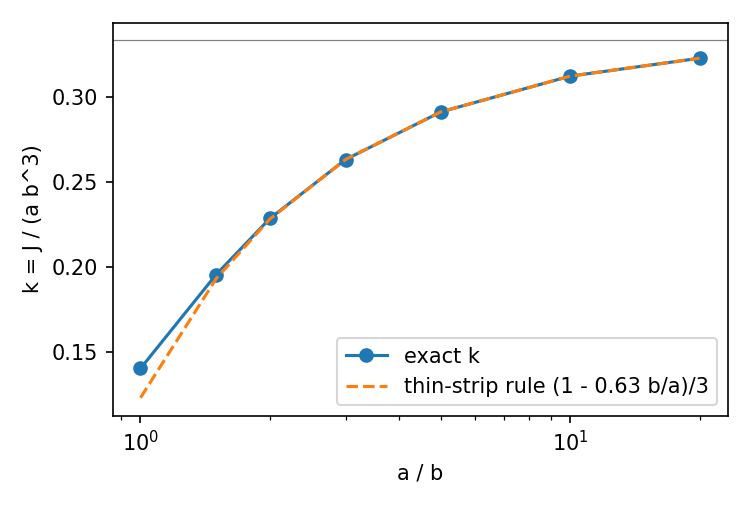
Run 08_beam_torsion.py until its CHECK line says PASS, and explain every line of it to your mentor. Then reproduce a known answer: A square bar's torsion constant is 0.1406 times the side to the fourth power; a long thin strip approaches 1/3.
Checkpoint: you reproduce a known answer and report how close you got.
Weeks 4 and 5
Ask your own question
Narrow the question above to one sentence that could turn out to be wrong, and write your prediction before you run anything. The first experiments below are a place to start.
Checkpoint: a one-page plan with your question and prediction.
Weeks 6 to 9
Run it, then measure the world
Solve for rectangles of many aspect ratios, compute the twist stiffness from each solution, then twist real bars and compare. Then step away from the screen: hang known weights from an arm attached to foam or wooden bars and measure the twist angle.
Checkpoint: one chart comparing your model with reality.
Weeks 10 to 12
Explain the gap, and share it
Work out why your model and your measurements disagree, test at least one explanation, and write it up yourself. Say which numbers came from the starter and which from the lab. Keep the honest limit in view: only rectangles are supported, and only small twists stay in the elastic range.
Checkpoint: a final paper, your code and a ten-minute talk.
The data
What the lab lets you change, how the project was checked before we listed it, and what the starter prints on a laptop.
Settings in the online lab
| Setting | Range | Starts at |
|---|---|---|
| Long side | 1 to 10 cm | 2 |
| Short side | 1 to 4 cm | 1 |
Checked on the research solver
| Solver (Poisson, 2D) | 1:1 beta 0.1404; 2:1 beta 0.2284; 4:1 beta 0.2804 |
|---|---|
| Known answer | 0.1406; 0.2287; 0.2808 |
| Error | 0.16% (limit 1.00%): passed |
| A first finding | beta = 0.1406 for the square, as published |
What the starter prints
From the run that built this page. Timings depend on your computer; the CHECK line must say PASS.
1:1 bar: k = 0.1403, series 0.1406, error 0.20%
2:1 bar: k = 0.2283, series 0.2287, error 0.18%
4:1 bar: k = 0.2802, series 0.2808, error 0.20%
CHECK torsion factor against the series -> PASS (limit 1%)
The starter code
One Python file that needs only numpy and matplotlib. Run python3 08_beam_torsion.py --show to see the plots. How to set up.
The model
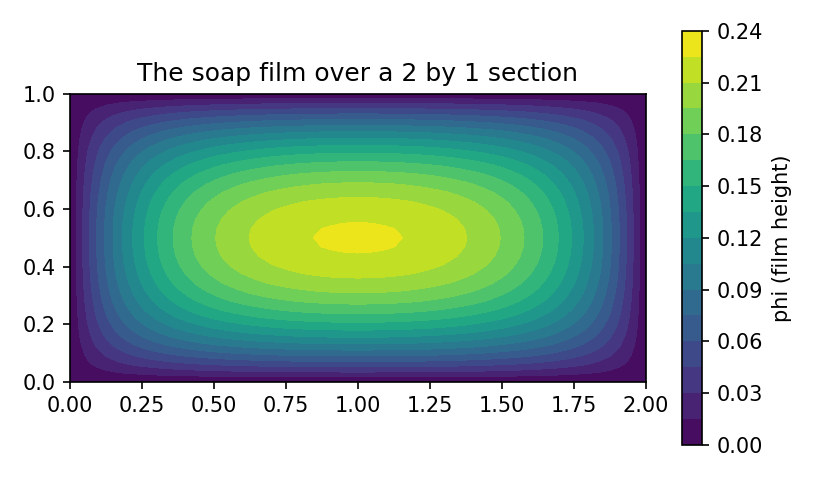
When you twist a bar, its stiffness comes from a "stress function" phi over the cross-section, shaped like a soap film blown up over a frame the shape of the section: -laplacian(phi) = 2 inside, phi = 0 on the edge. The torsion constant is J = 2 x (volume under the film). For an a by b rectangle (b the short side) write J = k a b^3. A square has k = 0.1406; a long thin strip approaches k = 1/3. Twist per length = torque / (G J), with G the shear modulus.
What it does
- Stage 1: run this file. It solves for phi on three rectangles and checks k against the exact series. The CHECK line should say PASS.
- Stage 2: twist real bars, measure their stiffness, and test the rule.
Your first experiments
From the YOUR TURN list at the bottom of the file. Write your prediction in your log before you run each one.
- A ruler is about 30 by 3 mm; a pencil about 7 by 7 mm. Predict which is stiffer in twist, and by how much, using J = k a b^3. Is the answer what your hands tell you?
- Where does the thin-strip rule (the dashed line) go wrong by more than 5%? Read it from the plot, then check.
- Experiment: clamp one end of a foam or wood bar, hang a weight from an arm at the other end, and measure the twist angle. Stiffness = torque x length / angle should be G J. Do bars of different shapes agree on G?
- Honest limit: only rectangles, and only small twists. Try a hollow square by setting phi to a constant on an inner hole, and say what changes.
The real world
Hang known weights from an arm attached to foam or wooden bars and measure the twist angle.
The honest limit
Only rectangles are supported, and only small twists stay in the elastic range.
Want to work on this one?
Members run it on the research solver in the lab and choose a mentor to guide them.